
Series: Life Lessons
Wednesday, August 19, 2026
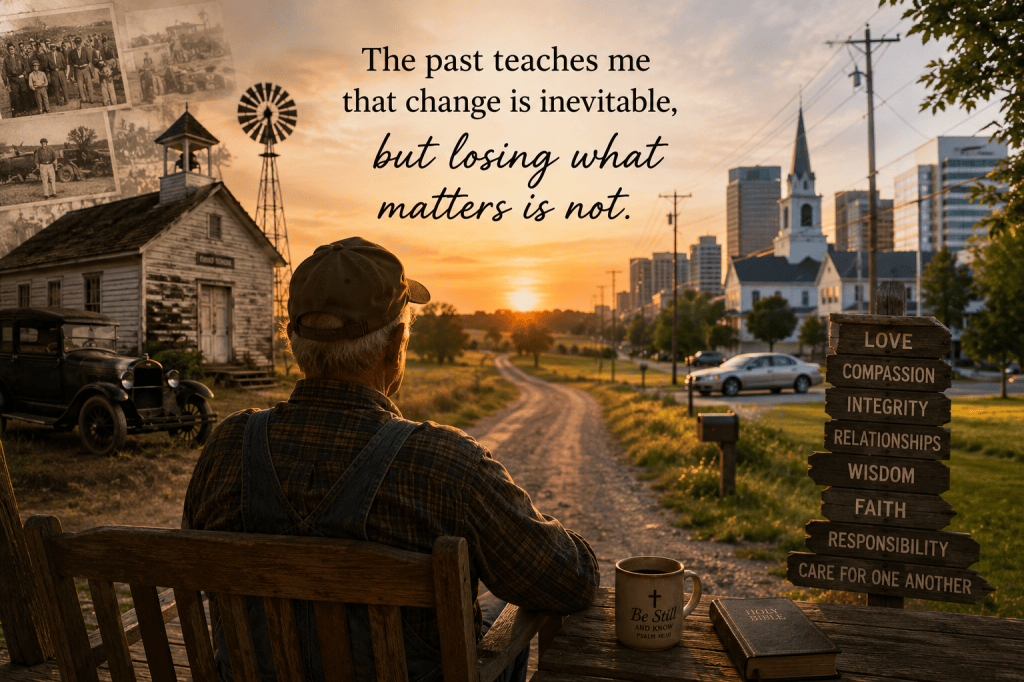
In my 76 years of living, I have seen a lot of things change.
I grew up on a family farm in Mississippi. Family farms were everywhere then. They were not just businesses. They were homes, ways of life, and often something one generation expected to pass along to the next. I have watched many of those farms disappear.
I have watched American manufacturing change and decline as factories closed or moved elsewhere.
I remember when a calculator seemed like quite an invention. Then came computers. Then cell phones. Now I carry around in my pocket a little device that can do things I could hardly have imagined as a boy.
I started school in a one-room schoolhouse with six grades and one teacher. Think about that for a minute. Today, children may attend schools with hundreds or even thousands of students.
I grew up in small country churches where everybody pretty much knew everybody else—and probably knew everybody else’s business, too. Today, some churches are so large that thousands of people can worship together without knowing the person sitting a few seats away.
Cars have changed. Houses have changed. Farming has changed. The way our food is produced has changed. The way we work, shop, communicate, travel, worship, and entertain ourselves has changed.
And if I am going to tell the truth, I have changed too.
My body certainly reminds me of that.
But more than my body has changed. My thinking has changed. My understanding has changed. There are things I believed when I was younger that experience has caused me to reconsider. I have learned some things along the way, and I have had to unlearn a few things too.
That is part of being a pilgrim.
The road changes, but so does the person walking it.
Some changes have made our lives better. Others have come with a price. And some changes are probably a mixture of both.
That makes me a little cautious whenever I hear somebody talking about going back to the “good old days.”
Which good old days?
There were wonderful things about the world in which I grew up. There are things about it I miss. There are lessons from those years that I hope we never forget.
But everything about those days wasn’t good.
Some things needed to change.
Maybe that is one of the most important things the past can teach us about the present:
Change is inevitable, but losing what matters is not.
Our task is not to preserve everything simply because it belonged to yesterday.
Our task is to learn what is worth carrying into tomorrow.
Love is worth carrying.
Compassion is worth carrying.
Integrity is worth carrying.
Wisdom is worth carrying.
Faith is worth carrying.
Responsibility is worth carrying.
And surely, in whatever kind of world our children and grandchildren inherit, caring for one another will still matter.
Those things don’t become obsolete.
A new invention cannot replace them. A bigger building cannot improve upon them. A faster automobile cannot outrun our need for them. And no computer can make the choices for us that determine what kind of people we will become.
I have come to understand life primarily through relationships: our relationship with God, our relationships with other people, our relationship with ourselves, and our relationship with the universe—the creation of which we are a part.
Everything surrounding those relationships may change.
The clothes will change.
The houses will change.
The machinery will change.
The technology will change.
The places where we live may change.
Even our understanding will continue to grow and change.
But the principles that help us live in right relationship with God, one another, ourselves, and creation have a way of outlasting the temporary things surrounding them.
Maybe that is why studying the past matters.
History isn’t asking us to move backward.
It helps us understand how we arrived here. It reminds us that people before us faced change too. They made choices about what to accept, what to resist, what to abandon, and what to preserve.
Now it is our turn.
The Curious Pilgrim cannot stop the road from changing.
I cannot make the world look like it did when I was a boy in Mississippi, and I am not sure I would want to.
But I can choose what I carry with me.
So perhaps the question the past asks us today isn’t:
How do we get back to the good old days?
Perhaps it is:
As we keep moving forward, what is too important to leave behind?


Leave a Reply