Category: Mentors Who Changed Me
Series: Who Challenges Me?
The Curious Pilgrim
I did not grow up studying the saints.
Of course, I had heard the names of some of them. In Bible College and Seminary, I encountered people such as Augustine, Ambrose, Francis of Assisi, and others as part of Church History. But studying someone historically is different from asking:
Why has the Church remembered this person for hundreds—or even thousands—of years?
For the past two summers, 2025 and 2026, St. James Episcopal Church in Springfield, Missouri, has offered a summer class on the Saints of the Church.
It has been a wonderful learning experience for me.
Each week we usually study three saints. Our Rector, the Rev. Isaac Petty-Pierjok, often groups them around a common characteristic or theme. Members of the class volunteer to research and present the life of one of the saints.
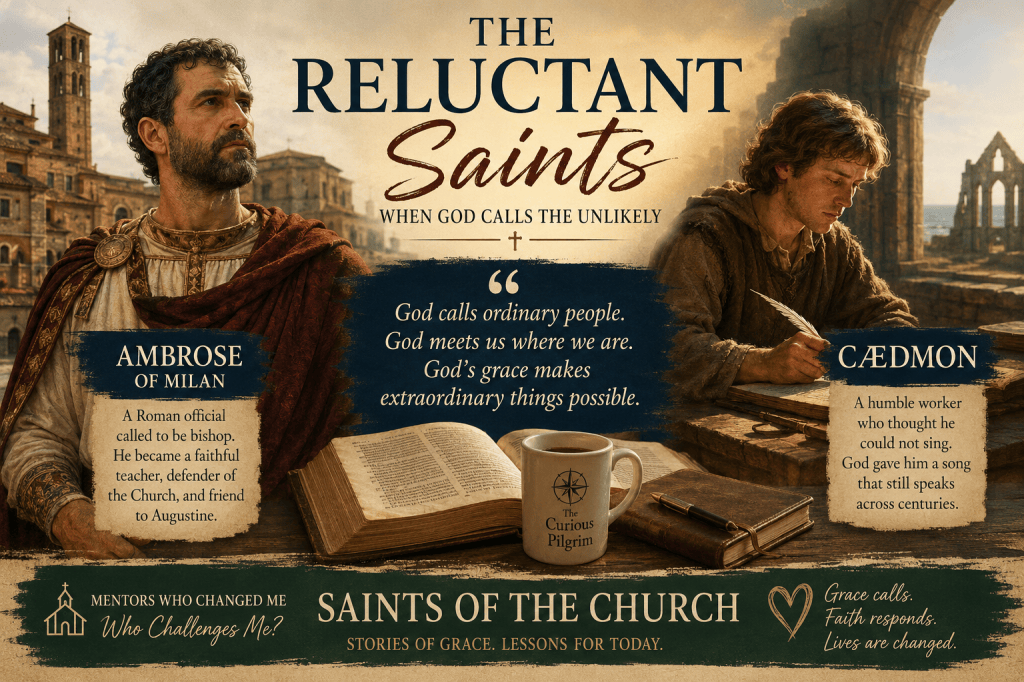
This summer I presented two: Ambrose of Milan and Cædmon.
As I studied them, something caught my attention.
I began thinking of them as the reluctant saints.
Not because they spent their lives resisting God, but because neither one began his story where we might expect to find a saint.
They did not begin as priests, bishops, monks, or great theologians.
They were doing something else entirely.
Ambrose: “You Want Me to Be Bishop?”
Ambrose of Milan was a Roman government official.
In the fourth century, he was serving as governor in northern Italy when the bishop of Milan died. The Christian community was deeply divided over who should become the next bishop, and Ambrose went to the church as a government official to help maintain order.
Then something unexpected happened.
The people began calling for Ambrose to become their bishop.
There was one rather significant problem.
Ambrose wasn’t even baptized.
He resisted the idea, but the people persisted. Eventually Ambrose accepted their call. He was baptized, ordained, and consecrated bishop.
The government official became one of the most influential bishops and teachers in the history of Christianity.
He would preach, teach, defend the Church, care for the poor, and influence another young man searching for truth—a man named Augustine, who would eventually become Augustine of Hippo.
I wonder what Ambrose thought when those people first started shouting his name.
Me?
You want me?
I’m not a bishop.
Perhaps God sometimes answers:
Not yet.
Cædmon: “I Cannot Sing”
Several centuries later, another unlikely saint appeared in England.
Cædmon worked with animals associated with the monastery at Whitby. He wasn’t known as a preacher, theologian, musician, or poet.
In fact, according to Bede’s account, Cædmon apparently couldn’t sing.
At gatherings, when people passed the harp around and took turns singing, Cædmon would leave when he saw the instrument getting close to him.
I can almost picture it.
Please don’t hand that thing to me.
One night after leaving such a gathering, Cædmon went to sleep near the animals.
During the night, he dreamed that someone told him:
“Cædmon, sing me something.”
His response was essentially the same thing he had been saying all along.
I cannot sing.
But he was told to sing about creation.
And Cædmon sang.
His song became what we know as Cædmon’s Hymn, one of the earliest surviving examples of Old English poetry.
His gift was eventually recognized by Hilda, the abbess of Whitby. Cædmon entered the monastic community and used his newfound ability to communicate the stories and teachings of Scripture through poetry.
The man who left the room because he couldn’t sing became remembered for his song.
Maybe That Is How Saints Are Made
These two men have made me reconsider what I mean when I use the word saint.
Ambrose didn’t wake up one morning planning to become one of Christianity’s great bishops.
Cædmon didn’t spend his childhood dreaming of becoming a Christian poet.
God met them where they were.
One was a government official.
One cared for animals.
Neither looked particularly like what we might imagine as “saint material.”
Yet each responded when the call came.
That may be one reason the Church continues to remember them.
Studying the saints is becoming important to me because I am discovering that their stories are not simply stories about extraordinary people from long ago.
They ask something of us.
They challenge us.
Ambrose challenges me to ask:
What if God calls me to something for which I do not feel prepared?
Cædmon challenges me to ask:
What if the thing I keep saying I cannot do is a gift I have not yet discovered?
And together they ask an even larger question:
Am I willing to let God call me from where I am instead of waiting until I become the person I think I ought to be?
Perhaps that is one of the lessons of grace.
God does not wait for us to become “saint material” before calling us.
God calls ordinary people.
Government officials.
People tending animals.
Teachers.
Writers.
Parents.
Workers.
Retirees.
People who feel prepared.
And people who most certainly do not.
The saints remind us of what can happen when ordinary people respond to an extraordinary grace.
Over the coming weeks, I want to introduce you to some of the saints I have been meeting through our classes at St. James.
I don’t simply want to tell you when they lived, where they lived, or what they accomplished.
I want to ask:
Why does the Church remember them?
What can their lives teach us about following Jesus?
And most importantly:
How do they challenge us today?
Ambrose said, in effect, I’m not a bishop.
Cædmon said, I cannot sing.
God had other possibilities in mind.
Who challenges me this week?
What am I saying I cannot do because I have not yet considered that God might be calling me to do it?
Perhaps the next time I find myself saying, “I can’t do that,” I should listen a little longer.
God may not be finished with the sentence.
The Curious Pilgrim — Reflections on faith, family, and mysterious grace.
 The Curious Pilgrim
Leave a comment