
The Seed of Mysterious Grace
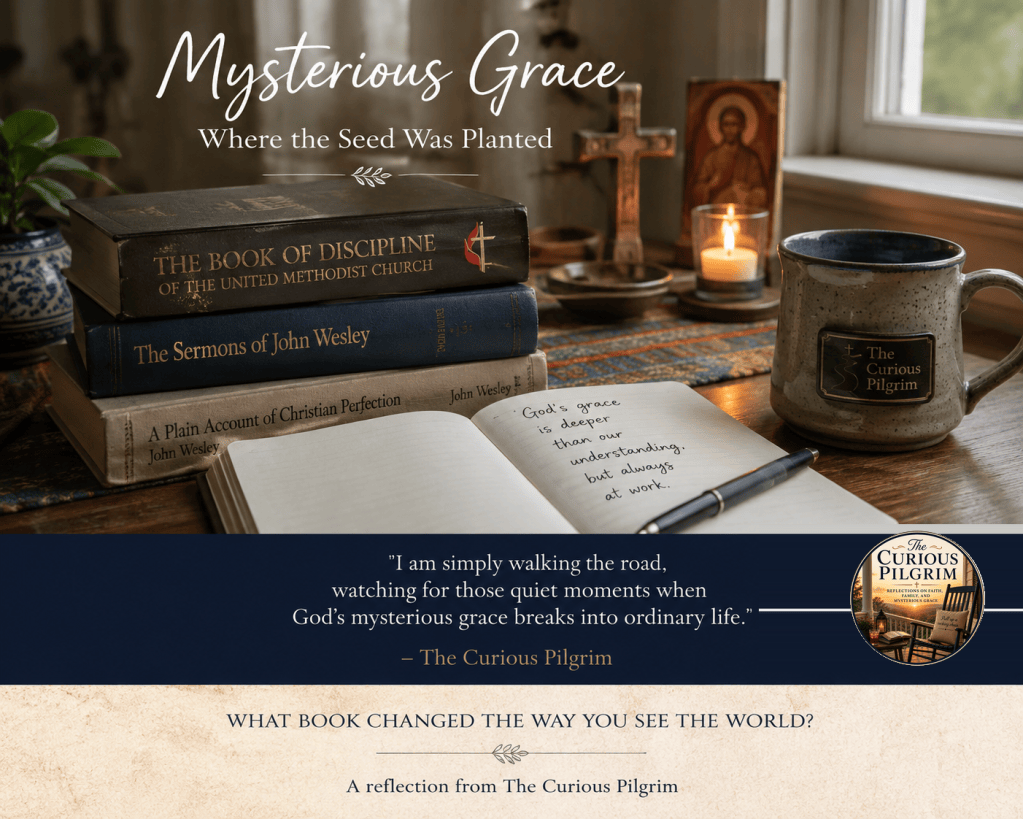
There are books that teach us facts, and there are books that quietly plant seeds that continue to grow long after we have closed their covers.
For me, one of those books was The Book of Discipline of The United Methodist Church. While studying at Memphis Theological Seminary, I was also immersed in the sermons and writings of John Wesley. Together, they introduced me to a way of seeing God that would forever change the direction of my life and ministry.
One phrase, in particular, captured my heart.
Grace is a mystery.
I learned that in Baptism and Holy Communion we encounter God in ways that cannot be fully explained. They are called means of grace because God is truly present and at work through them. We receive something real from God, even though we cannot fully describe how it happens.
At first, I understood this only as a theological idea.
Over the years, however, that idea became much more than a doctrine. It became the lens through which I began to see the world.
I started noticing God’s grace in places I had never expected to find it—in moments of joy and moments of sorrow, in forgiveness offered and forgiveness received, in unexpected friendships, in quiet conversations, and even in painful seasons that later revealed God’s faithfulness.
I realized that God’s grace is not confined to the walls of a church. It is constantly at work in the ordinary moments of everyday life.
That simple seed, planted in a seminary classroom many years ago, has continued to grow throughout my journey. Today, it shapes how I read Scripture, how I listen to others, how I understand my own story, and how I seek to walk with Christ.
It has even given a name to this ministry.
Mysterious Grace.
Not because God is distant or unknowable, but because God’s love is always deeper than our understanding. We may not always know how God is working, but we can trust that He is.
That is why I continue to call myself The Curious Pilgrim. I have not arrived at all the answers. I am simply walking the road, watching for those quiet moments when God’s mysterious grace breaks into ordinary life.
One day, I’ll share another story about how the image of the Table became one of the central symbols of this ministry. For now, it is enough to say that the seed planted in seminary continues to bear fruit.
Looking back, I realize that one book did not simply change the way I thought.
It changed the way I see the world.
And for that, I will always be grateful.


Leave a Reply